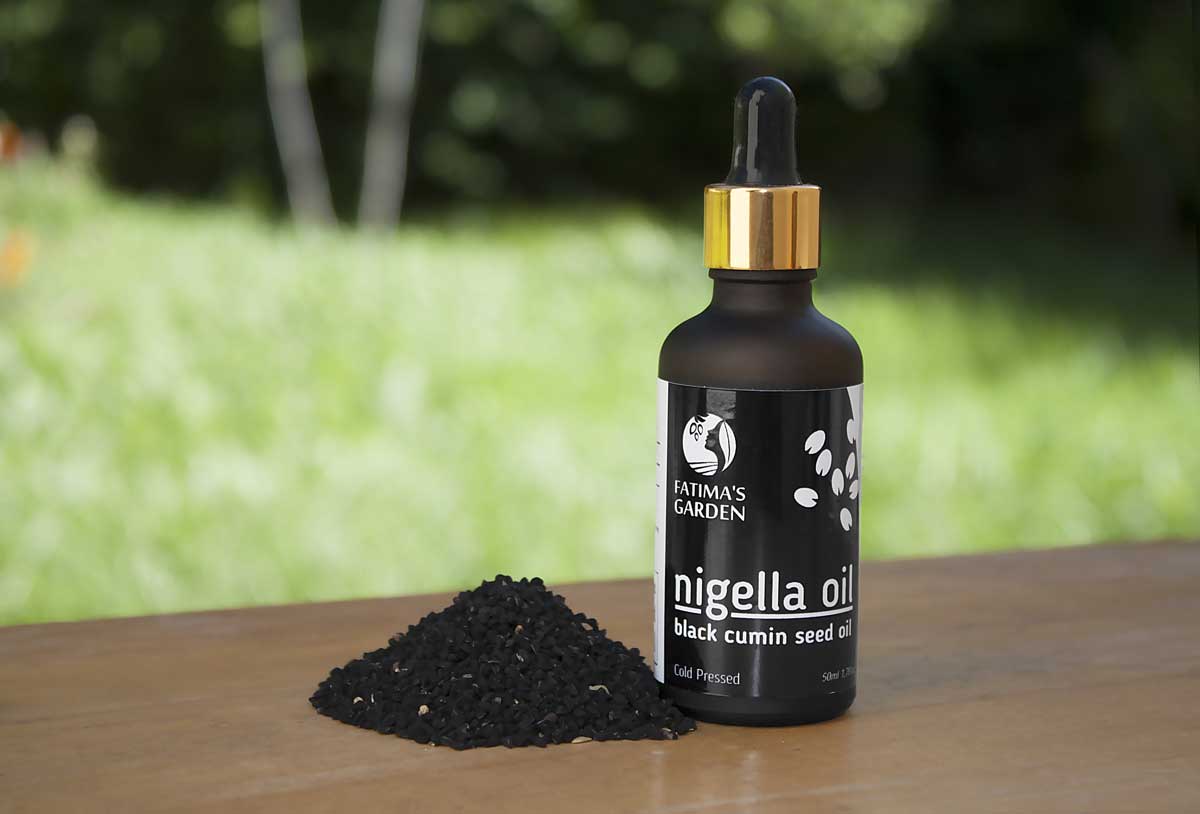
Nigella sativa seed oil, pressed in Morocco
Every other oil we sell is quiet. This one is peppery and a little bitter, and the first time you open it you will wonder whether it has turned. It has not. That smell is the oil, and this page is mostly about how to live with it.

We could take the smell out. Deodorising is a standard step, and most black seed oil on the shelf has been through it. We do not, and it is worth saying why.
Black seed oil carries an aromatic fraction that almost no other cosmetic oil has — thymoquinone is the best known part of it, and it is what your nose picks up. Removing it means heat, steam and a deodorising column, and that fraction is the first thing to go.
So the choice is an oil that smells of itself, or an oil that smells of nothing and has lost the part that made it distinctive. We take the first. It does mean the bottle announces itself when you open it, and that catches people out — which is the reason this page leads with it rather than burying it.
Black seed oil runs around 50 to 58 % linoleic acid — the omega-6 fatty acid the skin uses to build its own barrier, and the one it cannot make for itself. That is the plain reason skin holds its water better after a few weeks of it.
It is a rich oil, richer than argan and far richer than prickly pear. It sits on the skin a little longer before sinking in, which makes it useful on the dry places and too much on an oily face. On hair it is the opposite of a problem: the ends want exactly that weight.
Alongside the fatty acids it carries vitamin E, which is what keeps an unrefined oil from turning as fast as it otherwise would, and it is part of why cold-pressing is worth the lower yield.
What this is, and is not. Black seed oil is a cosmetic. It moisturises, it softens, it makes dry skin and dry hair look and feel better. It does not treat any illness or any skin condition, and we make no claim that it does. If you have a diagnosed condition, ask your doctor before adding anything to your routine. This oil can cause contact allergy in some people more readily than a neutral oil, so put one drop on the inside of the forearm and leave it a day before using it properly. If you are pregnant or breastfeeding, ask your doctor first.
Less than you think, and rarely on its own. Four ways that work, all of them built around the fact that it has a smell.
The smell fades in twenty minutes or so, but it is there. Use it before bed and it has gone by morning.
One drop of nigella into three of argan. You keep what the oil brings and the smell becomes a background note instead of the headline.
Part the hair, a few drops along the parting, massage, leave twenty minutes, then wash. The shampoo takes the smell with it.
It is a rich oil and the ends are the driest part of the hair. A drop rubbed between the palms, then drawn through the last few centimetres.
Published as ranges, because that is what the measurements give: the composition moves with where the seed grew and how it was pressed. Anyone quoting a single decimal figure for black seed oil is quoting one batch.
| Linoleic acid (omega-6) | 50 – 58 % |
|---|---|
| Oleic acid (omega-9) | 20 – 25 % |
| Palmitic acid | 12 – 16 % |
| Stearic acid | 2 – 3 % |
| Colour | Deep amber to dark gold |
|---|---|
| Odour | Peppery, faintly bitter, unmistakable |
| Texture | Rich — slower to sink in than argan |
| Characteristic compound | Thymoquinone |
| INCI name | Nigella Sativa Seed Oil |
The seed is cleaned, then cold-pressed once. Nothing is refined, nothing is deodorised, nothing is blended, and nothing is added — what goes in the bottle is what came out of the press, filtered.
Cold-pressing gets less oil out of a given weight of seed than pressing warm does. That is the trade: a lower yield, and an oil that still holds the aromatic fraction and the vitamin E.
In reusable glass, shipped worldwide with duties paid, so the price you see is the price you pay.
Not a list of everything we make — the three products black seed buyers actually put in the same basket. A third of them add the argan oil, which is also the oil we suggest mixing this one into.
 Argan oilIn a third of the baskets that hold this one. It is the oil people mix the nigella into — three drops of argan to one of this.from $21.60
 Prickly pear seed oilA quarter of them. Dry where the nigella is rich, and odourless, so the two divide the day between them.from $39.98
 Black soapA fifth. Where the hammam starts — an olive paste that lifts the dead skin first, so what follows reaches something.from $21.60