One mineral, one valley, seven formulas
Mined in the Moulouya valley, dried in the sun and sieved. Nothing is added to it and nothing is taken out. In water it swells, and what it holds on to is the oil on your skin — which is why it cleans without a single detergent.
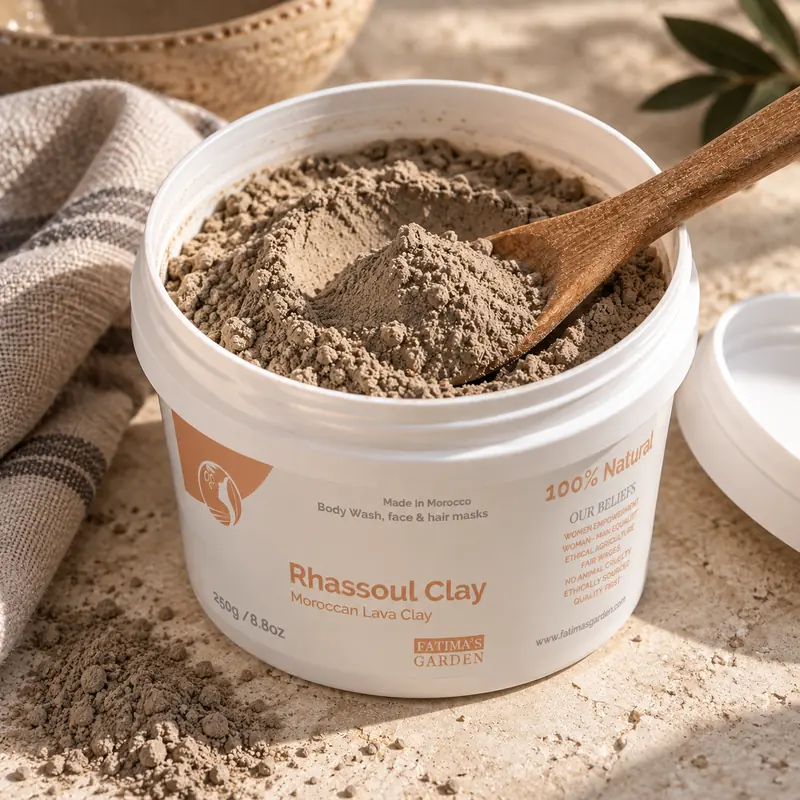
Ghassoul is a smectite — more precisely a stevensite, a clay built of microscopic plates stacked like pages. Put it in water and the stack swells: the plates separate, and every face of every plate carries a negative electrical charge.
Oil, sebum and the dust that sticks to them carry the opposite charge. They attach to the plates and leave with them when you rinse. Nothing has been dissolved, nothing has been emulsified: the clay has simply carried the oil away.
That is the whole mechanism, and it is the reason the skin afterwards feels soft rather than tight. A detergent takes the surface oil and then keeps going. Clay stops when it is full.
Plain about what it does. Ghassoul cleans, absorbs excess oil and leaves the skin matte and smooth. It is a cosmetic, not a treatment: it does not draw out toxins, it does not cure anything, and no clay does. If your skin is giving you trouble, ask a doctor rather than a jar. As with any new product, try a little on the inside of the forearm first.
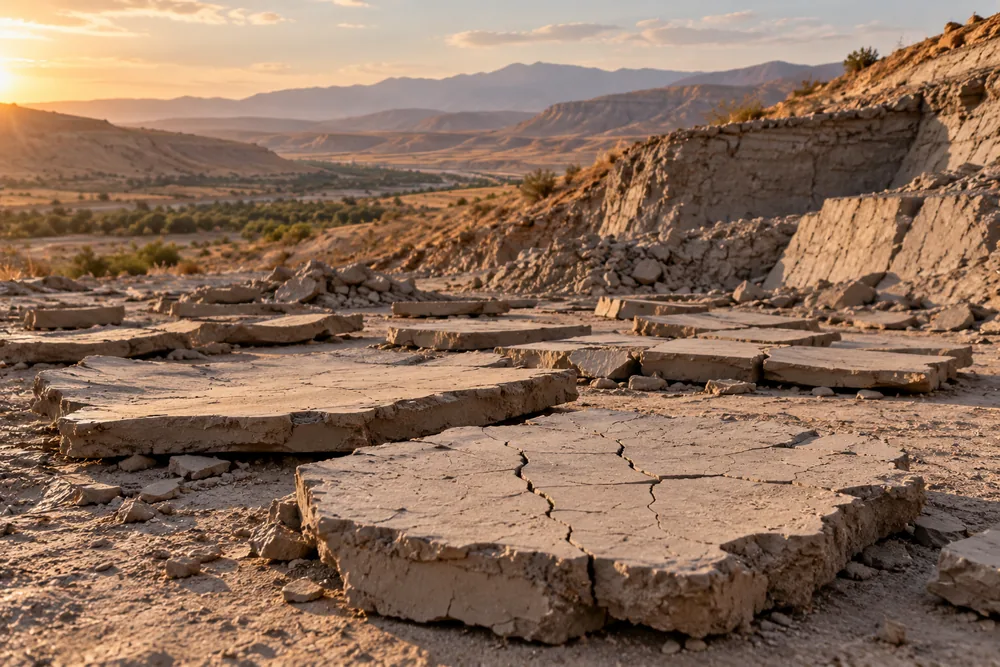
There is only one commercial deposit of ghassoul in the world, in the Moulouya valley on the eastern edge of the Middle Atlas. Every jar of real Moroccan ghassoul — ours included — comes from there. The clay is cut from the seam in slabs, laid out in the sun until it breaks, then crushed and sieved by machine to take out stone and grit.
That is the entire process. No washing, no bleaching, no firing, nothing added. What is in the jar is the seam, made small enough to mix with water.
Every one of them is the same Moulouya clay. What changes is what is milled into it — and, honestly, the smell. Every one comes in four sizes, from 150 g to a kilo.
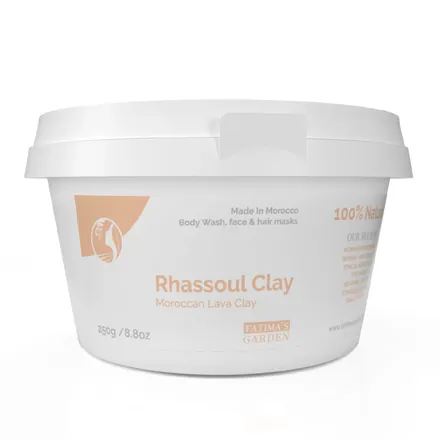 Pure ghassoulThe clay on its own. Take this one if you are unsure — and by the kilo.Choose this one →
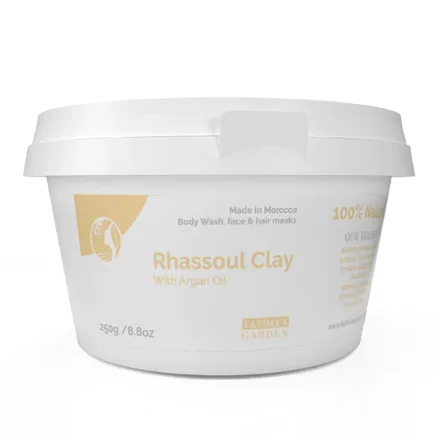 With argan oil and eucalyptusArgan oil worked in, eucalyptus for the smell. The version most hammams use.Choose this one →
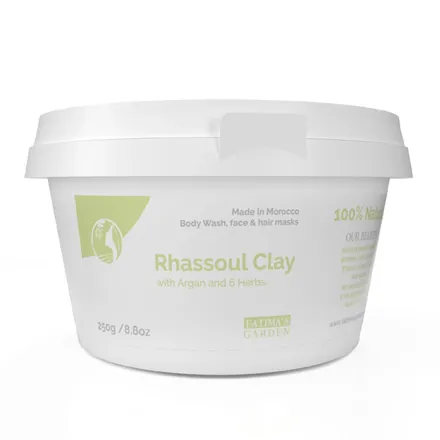 With argan oil and six herbsRose, lavender, thyme, rosemary, chamomile, eucalyptus. The most fragrant of the seven.Choose this one →
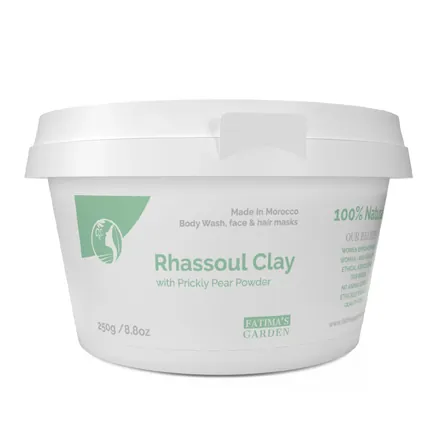 With prickly pear powderGround prickly pear. Chosen mostly by people who already use the seed oil.Choose this one →
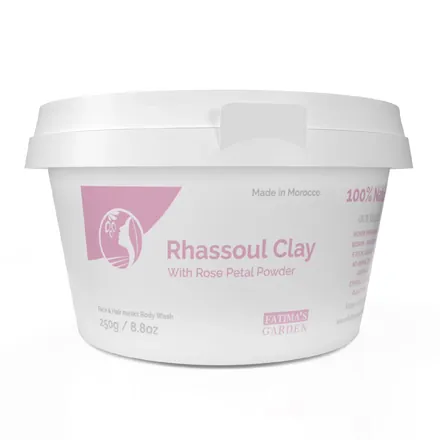 With rose powderGround Damask petals. The gentlest, and the one to mix with our rose water.Choose this one →
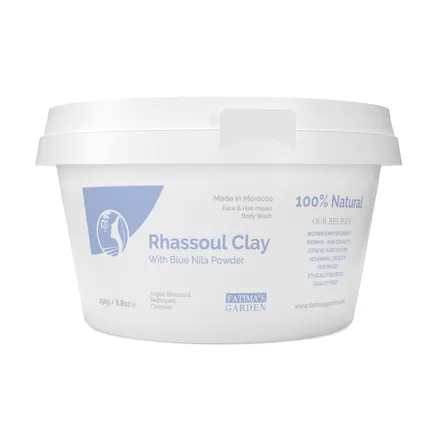 With blue nila powderNatural indigo. It turns the mask deep blue — a tradition of the north.Choose this one →
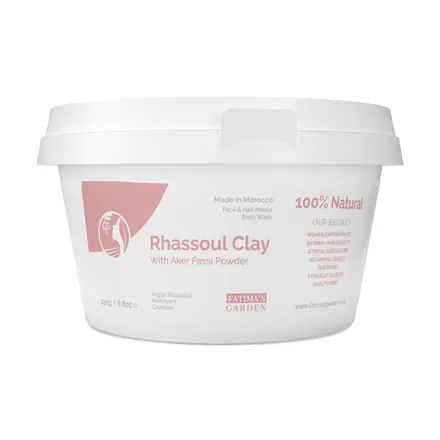 With aker fassi powderPoppy flower and pomegranate rind, the red powder of Fez. It tints the mask, not the skin.Choose this one →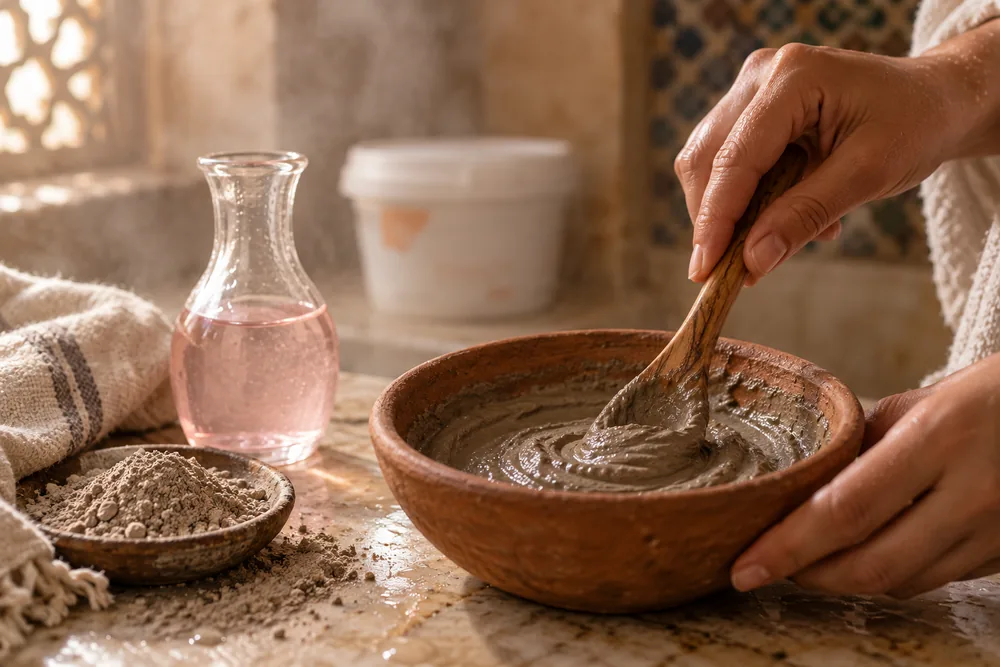
Four steps, and one rule that matters more than the rest: take it off before it dries.
MixTwo spoons of clay, enough warm water — or rose water — to make a paste the thickness of yoghurt. Never metal: a wooden or plastic spoon, in a bowl that is not metal either.
SpreadOn the face, the body or the scalp, avoiding the eyes. It should sit on the skin, not be rubbed in.
WaitFive to ten minutes on the face, up to fifteen if your skin is not sensitive. Take it off while it is still damp — a mask left to dry and crack is a mask left on too long.
RinseWarm water, with the fingertips moving in small circles. On hair, rinse longer than feels necessary. Then oil, while the skin is still damp.
Once or twice a week. Skin comes out matte and smooth rather than squeaky — that is the difference between binding oil and dissolving it.
Mixed thinner, worked through damp hair, left ten minutes. It washes without lather, which surprises people the first time. Hair comes out with body.
After the black soap and the kessa glove. The order matters: soap softens, the glove takes off, the clay finishes.
Instead of tap water, which is hard and alkaline almost everywhere in Europe. It is the pairing half our ghassoul customers end up buying.
A single line would do — clay — so here is what tells a real ghassoul from a grey powder sold as one.
| Mineral | Stevensite, a smectite clay |
|---|---|
| Origin | Moulouya valley, Morocco |
| Processing | Sun-dried, mechanically sieved |
| Additives | none |
| Preservative | none |
| INCI name | Moroccan Lava Clay |
| Shelf life | 5 years |
Real ghassoul is grey-brown, never white and never uniformly beige. Dropped into water it swells and goes slippery to the touch, almost soapy, within a minute; a kaolin or a bentonite sold as ghassoul stays gritty. And it smells faintly of wet stone. If a jar smells strongly of anything at all, the smell was added.
Do not mix it in a metal bowl or with a metal spoon — clay and metal react and the clay loses part of what makes it work. And do not leave the mask on until it cracks: dry clay pulls at the skin instead of lifting off it.
Seven formulas, four sizes, from 150 g to a kilo. Shipped worldwide with duties paid, so the price you see is the price you pay.
The hammam is a sequence, not a shelf of products. These three are what comes before and after the clay.
 Black soapIt comes first in the hammam: the soap softens, the clay finishes. Clay on skin that has not been softened does half the work.from $21.60
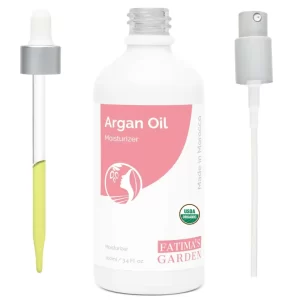 Argan oilThe clay leaves the skin bare; the oil goes on straight after, while it is still damp. This is the step people regret skipping.from $21.60
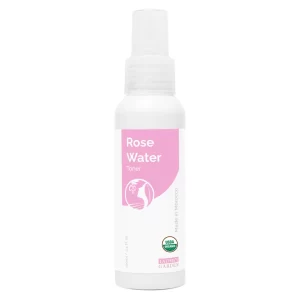 Rose waterWhat to mix the clay with instead of tap water. Rose powder formula and rose water is the pairing people come back for.from $21.60